


Comments
- No comments found

 Destination Gianyar Subak Pulagan Included in World Cultural Heritage



































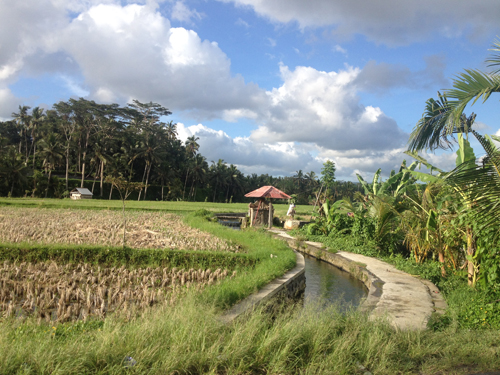 When hearing the word subak, the mind will immediately refer to the Island of the Gods. In Bali, subak is known as a social organization governing the irrigation system in rice field cultivation. One of the well-known subak organizations is the Subak Pulagan at Tampaksiring village, Tampaksiring subdistrict, Gianyar. Now, the UNESCO has included it as a World Cultural Heritage.
Chief of Subak Pulagan, Sang Nyoman Astika, delivered that Subak Pulagan had long been established and the oldest. On that account, its sanctity, customs and traditional impression were still prominent. It had been recognized as a World Cultural Heritage recently, precisely in November 2012. “The world has recognized so that we have to keep this area as a legacy for future posterity. Many investors are targeting the area to build villas and bungalows,” he said.
Subak here, continued Astika, consisted of five hamlets, namely the Tegal Suci, Penaka, Mantering, Buruan and Griya. The acreage of Subak Pulagan approximately reached 103 hectares with 240 water dividers. “Source of water comes from the northern region. Precisely, it is from Tirta Empul to southern extent of Kesah River. From Tirta Empul, the water flows through Timbangan pavilion at Pulagan rice field or approximately 2.5 km. From Timbangan pavilion, the water flow is divided into three channels. To the right side, it flows along 1 km, left side along 3 km and a small channel along 500 meters. Further, these channels are divided again into smaller channels flowing directly to rice fields of each farmer,” he explained.
Subak Pulagan, he explained, had a temple called Pulagan Temple or Ulun Suwi Temple. The temple had a statue resembling a yoni. “If a religious ceremony is held around the village and requires rice or holy water of Pulagan Temple, people will invoke and ask for permission here,” he said. Astika conveyed that Pulagan Temple had close relations to Goddess Sri because she was a symbol of fertility and prosperity. “There are several ceremonies held in this temple such as mamungkah, manca tirta and pakeling. Meanwhile, its piodalan or temple anniversary falls on Sukra Umanis Klawu. At that time, the ritual here is accompanied with dance performance, puppets and masks,” he said.
Aside from Pulagan Temple, he added, there were also other temples such as the Dalem Tambud and shrine of Timbang pavilion. “Tampaksiring village has several temples that at the same time also become tourist attraction like the Tirta Empul, Mengening and Gunung Kawi. Existence of the objects has an impact on the Pulagan rice fields,” he explained.
Travelers visiting the objects, said Astika, would be escorted further by tour guides to have a trekking and cycling tour in the surrounding rice fields of Subak Pulagan. Amidst the rice field, it had been made a concrete pathway. So, many travelers were interested to take trekking and cycling with a view of amazing rice field. They could see the activities of farmers who were cultivating their rice field in traditional system.
“The distance covered is 3 km and 4 km depending on the pathway selected. Other than trekking, the region also offers tubing sports. It is situated along the Pulagan River with the route of about 2 km. This water sport is managed individually,” he said. In addition to working as farmer, the residents of Tampaksiring also worked as private employees, teachers and laborers. “This area is part of Gianyar known as the town of the arts. On that account, there are many people who are deeply involved in the profession as the artist of carving, painting, dance and music,” he said.
With the inclusion of Subak Pulagan in the World Cultural Heritage, he hoped there would be a commitment of the government to pay more attention to the people in the area. By that way, people would not sell their rice field to investors. Some plots in the neighboring subak area had been sold and converted into tourist accommodation like bungalow. As consequence, it could diminish the value of cultural heritage. Now, Subak Pulagan in particular is still constructing a meeting hall. Meanwhile, other facilities such as road and toilets have been available. (BTN/Ocha)




The Buleleng Festival (Bulfest) taking place on August 4-8, 2015, is held at the monument…
MORE

In a tourism discussion some time ago at Sanur, it was revealed that the development…
MORE






Leave your comments