


Comments
- No comments found

 Destination Bangli Trunyan


































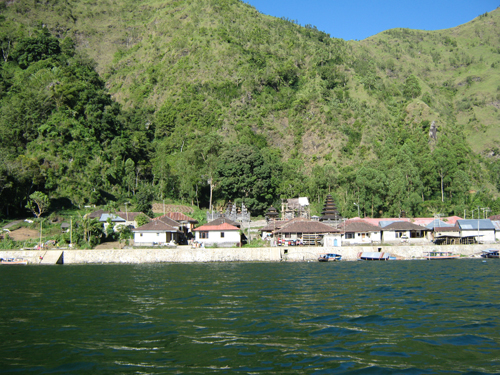 The village of Trunyan is squeezed tightly between the lake and the outer crater rim of Batur, an almighty volcano in Kintamani. This is a Bali Aga village, inhabited by descendants of the original Balinese, the people who predate the arrival of the Hindu Majapahit kingdom in the 16th century.
It is famous for the Pura Pancering Jagat temple, but unfortunately visitors are not allowed inside. There are also a couple of traditional Bali Aga-style dwellings, and a large banyan tree, which is said to be more than 1,100 years old. At Kuban sub-village close to Trunyan is a mysterious cemetery that is separated by the lake and accessible only by boat - there is no path along the steep walls of the crater rim.
The village of Trunyan itself is situated at the edge of Batur Lake. This location is inaccessible except by boat, and it takes around half an hour across the calm waters. Getting to Lake Batur takes around two hours drive to the northeast of Denpasar along the main road to Buleleng and through Bangli Regency.
Unlike the Balinese people, the people of Trunyan do not cremate or bury their dead, but just lay them out in bamboo cages to decompose, although strangely there is no stench. A macabre collection of skulls and bones lies on the stone platform and the surrounding areas.
The dead bodies don't produce bad smells because of the perfumed scents from a huge Taru Menyan tree growing nearby. Taru means 'tree' and Menyan means 'nice smell'. The name of Terunyan was also derived from these two words.
The women from Trunyan are prohibited from going to the cemetery when a dead body is carried there. This follows the deeply rooted belief that if a woman comes to the cemetery while a corpse is being carried there, there will be a disaster in the village, for example a landslide or a volcanic eruption. Such events have been frequent in the village's history, but whether women had anything to do with it is a matter of opinion...
You can visit both the village of Trunyan and the Kuban cemetery by chartered boat from Kedisan. Sadly, nowadays the boat trips are now blatant tourist traps, as touts and guides strongly urge you to donate your cash to the temple project or leave a donation for the dead. These touts ruin an otherwise fascinating experience.




The Buleleng Festival (Bulfest) taking place on August 4-8, 2015, is held at the monument…
MORE

In a tourism discussion some time ago at Sanur, it was revealed that the development…
MORE






Leave your comments